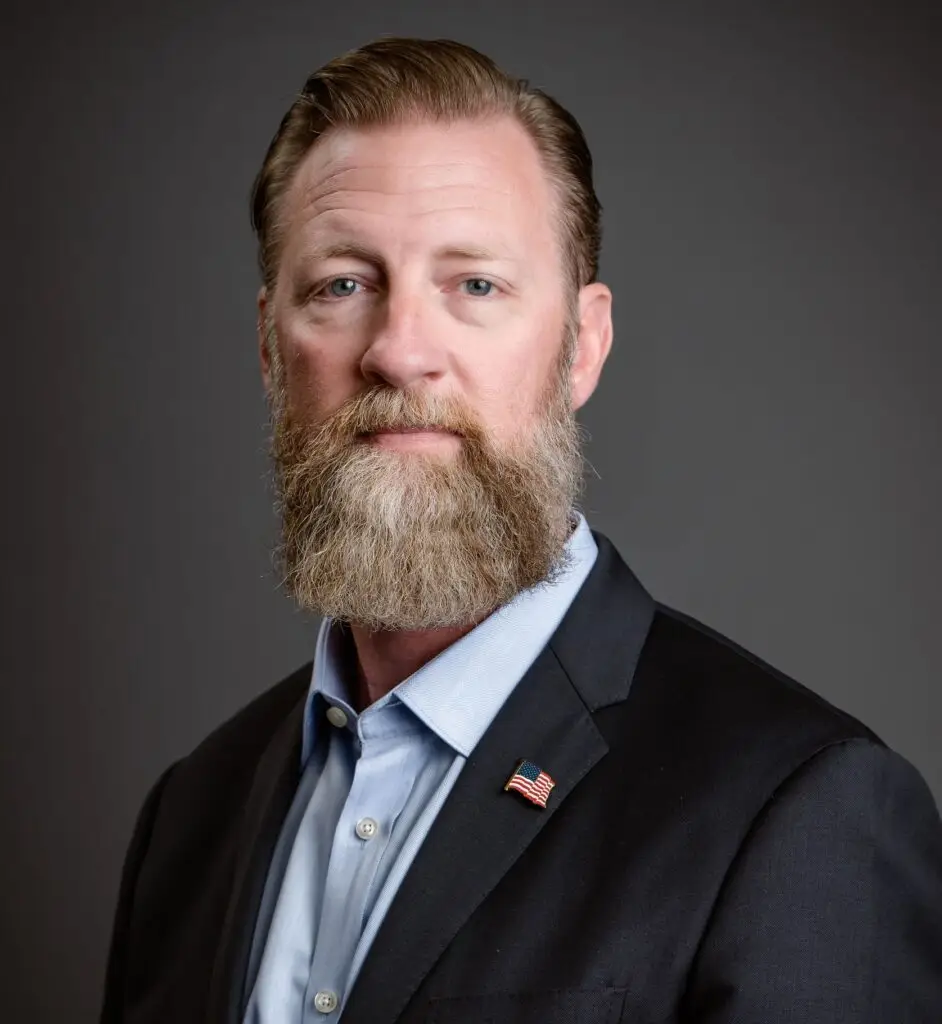

Veteran Leadership Lessons for
Small Business Owners
Decision-making under pressure. Building resilient teams. Executing strategy with limited resources. These aren't just military skills — they're the exact disciplines that separate small businesses that scale from those that stall. Here's how 23 years of Naval command translates directly to your business.
I spent 23 years in the United States Navy as a logistics and strategy officer. I planned complex operations under time pressure with incomplete information. I led teams through high-stakes environments where the cost of a bad decision wasn't a missed quarter — it was a failed mission. I built systems that had to work the first time, every time, with no margin for improvisation.
When I left the Navy and entered the corporate world — and eventually founded Leader's Edge Consulting — I discovered something that surprised me: the challenges small business owners face are more similar to military command than most people realize.
Not in scale or consequence. But in structure. The owner making a critical hiring decision with incomplete information. The team that isn't aligned on the mission. The operation that works when the leader is present but falls apart when they're not. The strategy that looks good on paper but fails on execution. These are the same problems, translated into a different environment.
What follows are the four leadership lessons from my Naval career that I've found most directly transferable to building and scaling a small business — and exactly how to apply them.
In the Navy, we had a principle that shaped how I approached every major decision under pressure: waiting for certainty is a decision in itself — and usually the wrong one. The environment rarely gives you perfect information. The enemy doesn't wait for you to be ready. You make the best decision you can with the information available, build in contingencies, and execute with commitment.
General Colin Powell popularized what's sometimes called the 40-70 Rule: if you have less than 40% of the information you'd want, you're acting on gut instinct and taking unnecessary risk. If you wait for 100%, the window has closed and someone else has moved. The target zone is 40–70% — enough to make a reasoned decision, not so much that you've lost the moment.
Small business owners face this constantly. The decision to hire before you're sure you can afford it. The decision to launch a new service before the demand is proven. The decision to cut a team member who's underperforming but whom you've worked with for years. These decisions rarely come with perfect information — and the owners who stall while waiting for certainty consistently lose ground to those who decide and adapt.
During a complex logistics operation off the coast of Bahrain, I had to make a resource allocation decision with incomplete intelligence about conditions at our destination port. I had two options: wait for full confirmation — which would delay the operation by 36 hours — or proceed with the best information I had and build in contingency protocols. We proceeded. The contingency protocols were triggered. The mission succeeded. Waiting for certainty would have cost us the window entirely. In business, that window is a market opportunity, a key hire, a critical client — and it closes whether you're ready or not.
How this translates to your business:
In the military, we don't fire people up with inspirational speeches before a mission. We give them the Commander's Intent — a clear, concise articulation of what we're trying to achieve, why it matters, and what success looks like. Then we trust the team to execute.
Commander's Intent is the military's solution to a problem that every business owner knows well: what happens when the plan meets reality and falls apart? If the team only knows the tactics — the specific steps they were supposed to follow — they freeze when conditions change. But if they understand the intent — the outcome they're working toward — they can adapt and still achieve the mission.
Most small businesses operate without Commander's Intent. The team knows their tasks. They don't know the mission. They know what they're supposed to do today — they don't know why it matters or what success looks like at the end of the quarter. So when something unexpected happens, they escalate it to the owner instead of handling it themselves.
This is why the owner becomes the bottleneck. Not because the team is incapable — but because clarity was never provided at a level that allowed them to operate independently.
Before every major logistics operation, my team received a brief that covered three things: the end state (what we're achieving), the constraints (what we cannot compromise on), and the decision rights (who has authority to call what, under what conditions). That's it. No 40-slide deck. No micromanagement. Just clarity on the mission — and then trust in the team to execute. The businesses I consult that perform best have the same dynamic. The ones that struggle are the ones where the owner skipped the brief.
Building Commander's Intent for your business:
"In the Navy, we don't motivate — we clarify. A team that knows the mission doesn't need a speech. They need a brief."
— Jim Hendley, Naval Commander (Ret.) · Leader's Edge ConsultingThere's an old military saying attributed to various generals across history: "Amateurs talk strategy. Professionals talk logistics." I spent most of my Naval career in logistics — and I can tell you this is not hyperbole. The most brilliant strategic vision fails without the operational backbone to execute it.
In a military context, logistics means getting the right people, equipment, and supplies to the right place at the right time, in the right condition. In a business context, it means the same thing: the right team in the right roles, the right systems in the right sequence, the right resources allocated to the right priorities.
Most small businesses that plateau do so not because their strategy is wrong — but because their logistics are broken. The service delivery process that only the owner can execute. The onboarding system that exists in someone's memory but not on paper. The client communication workflow that breaks down every time a key employee is out sick. These are logistics failures, and they're capping your growth just as surely as a supply chain failure caps a military operation.
The three logistics systems every scaling service business must have:
In logistics planning, we obsess over what we call "single points of failure" — any element of the operation where, if one thing goes wrong, the entire mission fails. We design around them. We build redundancy. We never let critical capability reside in a single person, a single vehicle, or a single supply route. Most small businesses I consult have multiple single points of failure — and they're usually the owner. Your most important logistics project is building a business that doesn't break when you're not there.
The most misunderstood leadership concept I encounter in small businesses is accountability. Many owners avoid it — not because they don't want results, but because they've been conditioned to think accountability means confrontation, criticism, or punishment. It doesn't.
In the military, accountability is the foundation of trust. When a sailor knows that standards are enforced consistently — that results are measured, that excellence is recognized, and that underperformance is addressed — they feel safe. They know the rules of the game. They know what's expected. And they know that everyone around them is being held to the same standard.
The absence of accountability is not kindness. It's the most expensive form of disrespect a leader can show their team. When you don't hold someone accountable, you're communicating that you either don't trust them to do better, or you don't care enough to invest in their development. Neither message builds a high-performing team.
The most effective leaders I served under shared one characteristic: they held the standard without making it personal. They didn't yell. They didn't shame. They stated the expectation clearly, asked what got in the way, addressed the obstacle if it was legitimate, and held the line if it wasn't. That combination — high standards, genuine support, consistent enforcement — is what builds the kind of team that performs when the pressure is highest. It works the same way in a small business as it does on a Navy ship.
How to build a culture of accountability without the confrontation:
- Define the standard first. You cannot hold someone accountable for a standard they were never clearly given. Write it down. Confirm it was understood. Then measure against it.
- Separate the person from the behavior. "This report was incomplete" is accountable feedback. "You always do this" is not. Precision matters.
- Address it early. Accountability gets harder the longer you wait. A quick conversation at the first sign of a pattern is far easier — for both parties — than a difficult conversation six months later.
- Recognize excellence at the same frequency you address gaps. Accountability culture without recognition culture becomes a pressure cooker. Both are necessary.
- Model it yourself. The fastest way to destroy an accountability culture is for the leader to hold others accountable while exempting themselves. Own your mistakes openly and with specificity.
A Note to Fellow Veterans in Business
If you served, you already have more of what it takes to build a great business than you probably give yourself credit for. You know how to make decisions under pressure. You know how to lead a team through uncertainty. You know what it means to be accountable for a mission that's bigger than yourself.
What often trips up veteran entrepreneurs isn't capability — it's translation. The instinct to lead from the front can make it hard to delegate. The commitment to high standards can make it hard to tolerate the messiness of a growing team. The mission-focused mindset can make it hard to slow down long enough to build the systems that would make the mission sustainable.
Your military training is a competitive advantage — but only if you translate it deliberately. The instincts you developed in service are real and valuable. The challenge is learning which ones to apply directly, which ones to adapt, and which ones to consciously override when the business context demands something different. That translation process is exactly the work of a good executive coach — and it's work that veteran entrepreneurs tend to move through faster than most, because the foundational disciplines are already there.
The businesses I've seen veteran entrepreneurs build, when they lean into the disciplines above, are consistently among the most resilient, most loyal, and most operationally sound in their industries. Not because veterans are smarter — but because they've been trained, in the most demanding possible environments, to do the things that great business leaders do: make decisions, hold standards, build systems, and lead people through uncertainty.
"You've already done the hardest leadership training that exists. The question isn't whether you have what it takes — it's whether you're applying it deliberately."
— Jim Hendley, Naval Commander (Ret.) · Leader's Edge ConsultingBringing It All Together
These four lessons from military command aren't abstract philosophy. They're operational disciplines that I have applied in some of the most demanding environments in the world — and that I've watched transform service businesses that were stuck, overwhelmed, or plateaued.
The translation isn't always obvious, and it's rarely automatic. But the foundation is the same: clarity of mission, quality of decision-making, strength of systems, and integrity of accountability. Get all four working together, and you have a business that doesn't depend on the owner being present for every decision. You have a team that operates with the kind of disciplined confidence that clients can feel. You have an organization built to scale — not just to survive.
- Lesson 1 — Decide at 70%: Stop waiting for certainty. Make the best decision with the information you have, build in contingencies, and execute with commitment.
- Lesson 2 — Commander's Intent: Give your team the end state, the constraints, and the decision rights — then trust them to execute without you in every conversation.
- Lesson 3 — Logistics Win Markets: Document your delivery, eliminate single points of failure, cross-train your team, and build operational resilience before you need it.
- Lesson 4 — Accountability is Respect: Hold the standard without making it personal. Recognize excellence with the same frequency you address gaps. Model it yourself.
Ready to bring military-grade leadership to your business?
Book a free strategy call and walk away with a clear picture of which leadership discipline to build first — and how to do it in your specific business context.