

The Tyranny of the Urgent:
How to Prioritize When Everything Feels Like a Fire
The number one challenge I see with the business owners and executives I work with is their ability to prioritize effectively. They aren't short on effort — they're short on focus. Here's the framework I use to silence the noise, anchor every day to the mission, and put your best hours on the work that actually moves the business forward.
The number one challenge I see with the business owners and executives I work with is their ability to prioritize effectively. They aren't lazy. They aren't unmotivated. They aren't lacking ideas. What they're lacking is a way to tell the difference between what's loud and what's important.
The phone rings. The text comes in. A client throws a curveball. An employee needs a decision yesterday. By the time you look up, the day is gone — and somehow, none of the things you said mattered most actually got touched.
That's the tyranny of the urgent. It's the quiet thief that steals years from business owners who are working harder than ever and still wondering why the needle won't move.
In 23 years in the Navy, I learned a hard lesson: the mission doesn't care how busy you are. It cares whether the right things got done. Activity is not the same as progress. Motion is not the same as movement. And when you confuse the two, you end up exhausted at the end of a year that didn't actually take you anywhere.
Below is the framework I teach my clients. Eight principles, anchored to one truth: discipline is choosing. Without choice, you don't have priorities — you have a to-do list driven by whoever yelled last.
Start With the Mission
Before we ever get to tactics, time blocks, or the word "no," we have to start where prioritization actually begins: your mission.
Not your task list. Not your inbox. Not whatever fire is burning right now. Your mission — the specific reason this business exists, the outcome it's built to produce, and the person it's built to serve.
This is the part most owners skip, and it's the reason their prioritization system collapses inside of a month. You cannot prioritize against a vacuum. If you don't know what you're aiming at, every request feels equally important — because nothing has anything to be measured against.
The owners who win at this revisit the mission constantly. Not once a year at a planning retreat. Weekly. Sometimes daily. They write it down. They post it where they'll see it. They start the morning by asking one simple question:
"Is what I'm about to spend the next hour on actually moving me toward the mission — or just reacting to the loudest voice in my inbox?"
— THE FIRST QUESTION OF THE DAYThat question — asked honestly, asked often — is worth more than every productivity app on your phone.
The 8 Principles, at a Glance
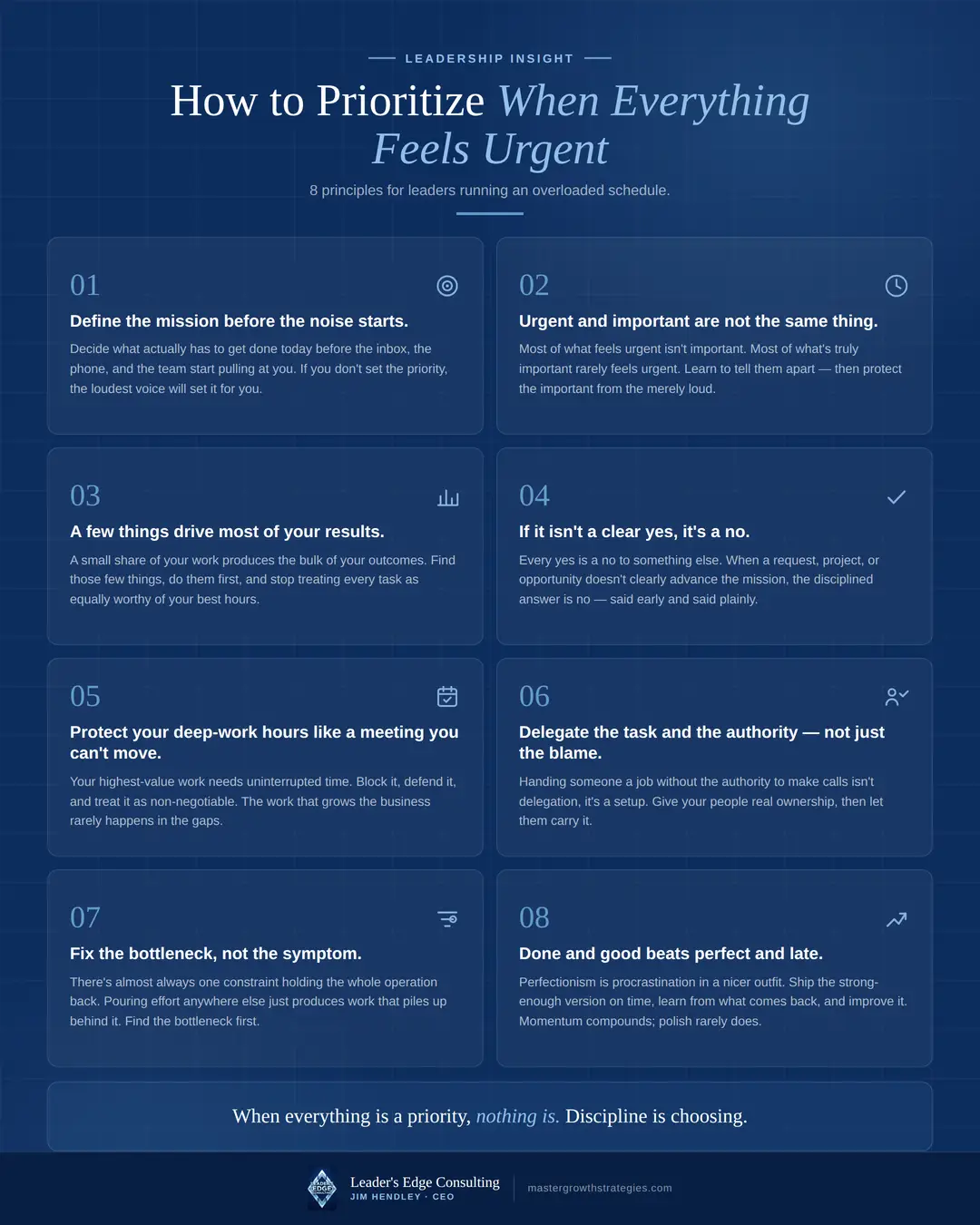
Here's the full framework on one page. Print it. Keep it where you work. We'll unpack each principle below.
Principle 1: Define the Mission Before the Noise Starts
Decide what actually has to get done today before the inbox, the phone, and the team start pulling at you. If you don't set the priority, the loudest voice in your day will set it for you — and the loudest voice is almost never the most important one.
This is a ten-minute habit, and it changes everything. The night before, or first thing in the morning before you touch a screen, write down the two or three things that — if nothing else gets done today — would still make this a winning day. Those are your priorities. Everything else is negotiable.
Principle 2: Urgent and Important Are Not the Same Thing
This one principle, fully internalized, will change how you run your business.
Most of what feels urgent isn't important. Most of what's truly important rarely feels urgent. The fire in your inbox is urgent. The strategy session for your next quarter is important. Most owners spend 80% of their time on the first and 20% on the second — and then they wonder why the business isn't growing.
Learn to tell them apart — then protect the important from the merely loud.
Principle 3: A Few Things Drive Most of Your Results
A small share of your work produces the bulk of your outcomes. Twenty percent of your clients, twenty percent of your services, twenty percent of your activities — these are quietly carrying the business while you spend most of your week on the other eighty.
Find those few things. Do them first. Stop treating every task as equally worthy of your best hours. Your best hours are a finite resource. Spend them where they actually compound.
Principle 4: If It Isn't a Clear Yes, It's a No
This is where most owners lose the game. Not because they're bad at strategy. Because they cannot say no.
Every yes you give to one thing is a silent no to something else. When you say yes to the meeting that didn't need to happen, you're saying no to the deep work that grows the business. When you say yes to the discount client who drains your team, you're saying no to the margin and the energy you need for the right client.
Every yes is a no to something else. When a request, project, or opportunity doesn't clearly advance the mission, the disciplined answer is no — said early and said plainly. The best leaders I know aren't the ones who can do the most. They're the ones who've learned to do the right things and let the rest go.
"No" doesn't have to be harsh. "That's not the right fit for us right now" is enough. "I appreciate the opportunity, but I have to pass" is enough. What you can't do is keep saying yes and then resenting your own calendar.
Principle 5: Protect Your Deep-Work Hours Like a Meeting You Can't Move
Your highest-value work — the strategic thinking, the planning, the work that actually grows the business — needs uninterrupted time. Block it on the calendar. Defend it like a client meeting. Treat it as non-negotiable.
The work that grows the business rarely happens in the gaps between other things. It happens when you give yourself ninety uninterrupted minutes and a closed door. If you don't put it on the calendar, it doesn't happen — because everything else will always be louder.
Principle 6: Delegate the Task — and the Authority
Handing someone a job without the authority to make decisions about it isn't delegation. It's a setup. They're going to come back to you on every small call, every gray area, every judgment — and you'll feel like you're still doing the work, except now with extra steps.
Real delegation has three parts:
- The outcome — what success looks like, in clear terms
- The authority — what they can decide without coming to you
- The accountability — when and how you'll check in
Give people real ownership. Then let them carry it. You hired them to make calls. Let them make some.
Principle 7: Fix the Bottleneck, Not the Symptom
There's almost always one constraint holding the whole operation back. One process, one role, one decision, one client that's the actual bottleneck — and pouring effort anywhere else just produces work that piles up behind it.
Before you launch another initiative, ask: what is the one constraint that, if I solved it, would unlock the most progress? Fix that. Then ask the question again. This is how businesses scale — by working on the right thing, not by working on more things.
Principle 8: Done and Good Beats Perfect and Late
Perfectionism is procrastination in a nicer outfit. The proposal that sits on your desk for two weeks getting "polished" doesn't beat the strong-enough version that went out on Tuesday. The launch you keep delaying for one more revision doesn't beat the launch that's actually in market and learning.
Ship the strong-enough version on time. Learn from what comes back. Improve it. Momentum compounds. Polish rarely does.
Stay Connected to the Mission — Constantly
Here's what I want you to take from all eight principles combined: they don't work without a mission to anchor them to.
A priority is not "what feels most important right now." A priority is "what most advances the mission this business exists to fulfill." Without the second half of that sentence, prioritization becomes a popularity contest among whatever is loudest in your head.
The owners I coach who actually escape the tyranny of the urgent share one habit in common. They reconnect to their mission frequently and deliberately. Weekly reviews. Daily morning check-ins. Quarterly resets. Sometimes a literal note taped above the desk.
Not because they need to be reminded what the mission says — they already know. They reconnect because the act of reconnecting is what gives them the clarity and the courage to say no to everything that doesn't fit.
"You can't say no with confidence to what doesn't matter until you've said yes with conviction to what does."
— JIM HENDLEY, COMMANDER USN (RET.) · LEADER'S EDGE CONSULTINGThe Traps That Catch Even Disciplined Owners
I've watched some of the most disciplined owners I know fall into the same handful of traps. Naming them out loud is usually enough to start avoiding them.
- Confusing busy with productive. A full calendar isn't evidence of a well-run business. It's often evidence of weak boundaries.
- Saying yes to keep the peace. Every reluctant yes builds resentment — usually toward people who never asked you to over-commit in the first place.
- Doing what's comfortable instead of what's important. The familiar task is always easier to start than the strategic one. That's exactly why the strategic one rarely gets done.
- Letting the inbox set the agenda. Your inbox is a list of other people's priorities. It should not be the first thing you touch in the morning.
- Working on everything, finishing nothing. Eight projects at 70% is worth less than three projects at 100%. Finish things.
Discipline Is Choosing
The owners who break out of the tyranny of the urgent don't do it by working more hours. They do it by choosing better hours.
They get clear on the mission. They name the two or three things that actually move it forward. They put those things on the calendar and protect them. They say no — kindly, plainly, and often — to everything that doesn't fit. And they reconnect to the why behind it all so often that the noise loses its grip.
That's the whole game. Not more effort. More clarity. Not more activity. More alignment.
When everything is a priority, nothing is. Discipline is choosing — and choosing is the work.
- Define the mission before the noise starts — set the day before the day sets you.
- Urgent and important are not the same thing — protect the important from the merely loud.
- A few things drive most of your results — find them, do them first.
- If it isn't a clear yes, it's a no — every yes is a no to something else.
- Protect deep-work hours like a meeting you can't move — the business grows in the blocks you defend.
- Delegate the task and the authority — ownership without authority isn't real delegation.
- Fix the bottleneck, not the symptom — solve the constraint, unlock the system.
- Done and good beats perfect and late — momentum compounds; polish rarely does.
Tired of ending the week busy but not better?
Book a free strategy call and we'll walk through your specific situation — your mission, your bottleneck, and the two or three changes that will free up your best hours for the work that actually moves the business.